
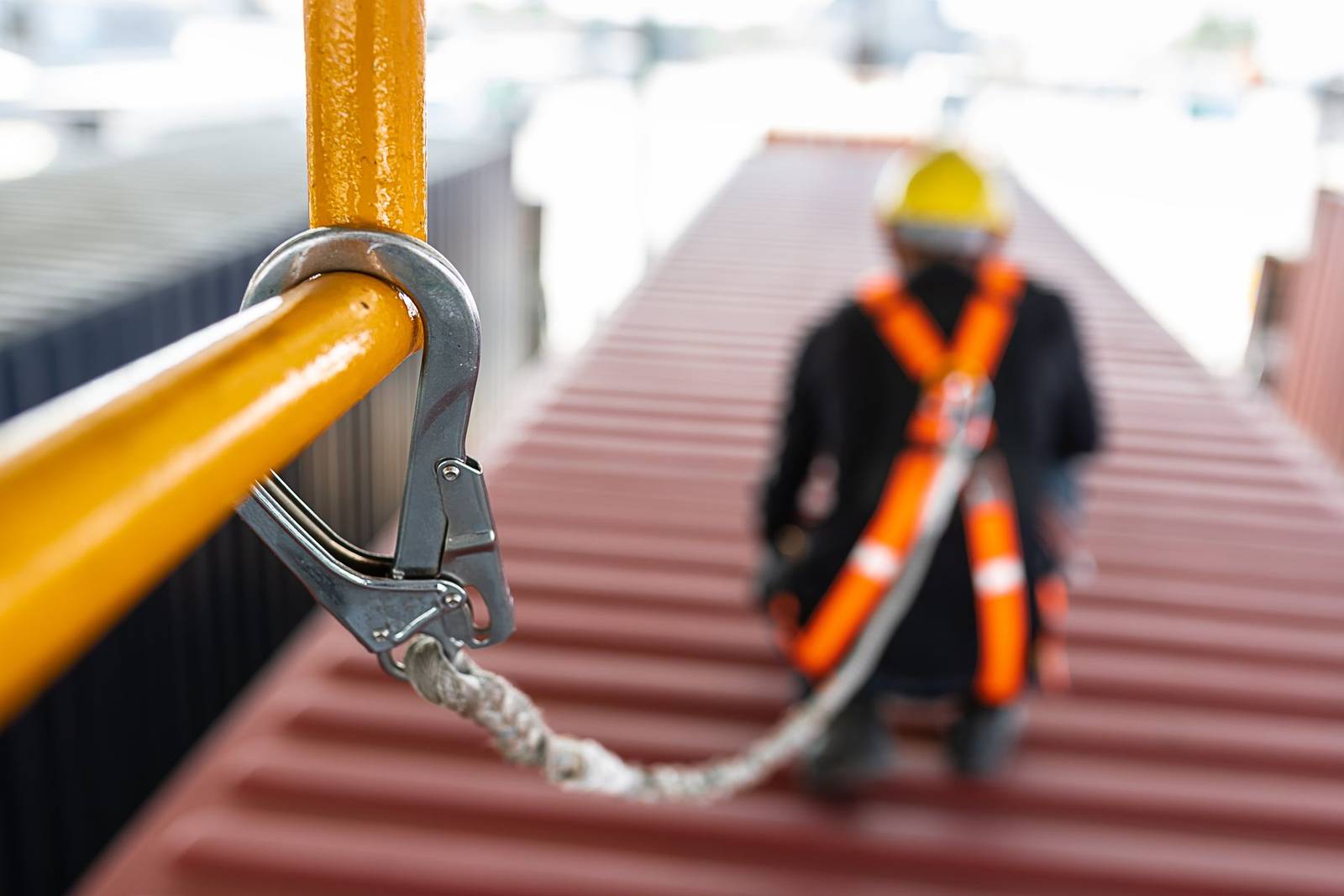
Falls are the leading cause of death in construction, and fall protection (29 CFR 1926.501) has been OSHA’s most frequently cited standard for more than a decade running — with fall protection training requirements (1926.503) usually sitting in the top ten right beside it. Read that pairing carefully: employers get cited both for the missing guardrail and for the crew that was never trained to recognize the hazard in the first place.
3P Safety Training delivers both levels of the fix on-site: authorized-user training for everyone who ties off, and competent-person training for the people your company designates to inspect systems, spot hazards, and shut work down. Your crew trains on the equipment they wear and the structures they actually work on — not a hotel conference room’s idea of a leading edge.
The Rules: Where Fall Protection Is Required and by Whom
Two regimes cover most employers, and plenty of companies straddle both:
- Construction — 29 CFR 1926 Subpart M. Fall protection is required at 6 feet above a lower level (with specific rules for leading edges, holes, roofing, formwork, and excavations). 1926.502 sets the criteria for guardrails, nets, and personal fall arrest systems, and 1926.503 requires a competent person to train every exposed employee.
- General industry — 29 CFR 1910 Subpart D. The walking-working surfaces rule requires protection at 4 feet, pulls in fixed ladders and rooftop work, and its training section (1910.30) requires a qualified person to train employees who use personal fall protection.
Both regimes lean on a designated competent person — defined in 1926.32(f) as someone capable of identifying existing and predictable hazards and with the authority to take prompt corrective action. The title is not honorary. When a compliance officer walks your site, “who is your competent person for fall protection?” is one of the first questions asked, and “the foreman, I think” is not an answer that ends well.
Two Courses, One Standard of Documentation
We deliver fall protection at the two levels OSHA’s framework expects, and the comparison matters when you decide who attends which:
| Authorized User | Competent Person | |
|---|---|---|
| Who it’s for | Every employee who works at height or uses a harness | Foremen, superintendents, safety leads — the designated hazard-spotters |
| Typical length | Half day, on-site | Full day, on-site |
| What it covers | Hazard recognition, system use, donning and inspecting a harness, tie-off discipline | Everything in user training plus system selection, anchorage evaluation, inspections, plan development, rescue planning, and stop-work authority |
| What it authorizes | Working at height under your fall protection plan | Inspecting equipment, supervising setups, training and correcting the crew, signing the plan |
| Documentation | Written test + training certification per 1926.503(b) | Written and practical evaluation + designation letter for your program |
What the Training Covers
Built around Subpart M and the ANSI/ASSP Z359 fall protection code, taught with your site’s specifics:
- The fall hazards on your site — leading edges, holes and skylights, roof work, ladders, elevated platforms, and the 6-foot/4-foot trigger heights that apply to your work
- The hierarchy of controls: elimination, guardrails and passive systems, restraint, and personal fall arrest as the last line — not the first reflex
- Personal fall arrest systems (PFAS) — the ABCs done properly: anchorage strength (the 5,000-pound rule and engineered 2:1 systems), body harness fit and donning, connectors, and self-retracting lifelines versus shock-absorbing lanyards
- Clearance and free-fall math — total fall distance calculated the way it kills people when it is skipped: free fall, deceleration, harness stretch, and the safety margin below the worker
- Swing fall, sharp edges, and the tie-off mistakes experienced crews still make
- Equipment inspection — pre-use checks by the user, documented periodic inspection by the competent person, and the removal-from-service criteria nobody argues with
- Rescue planning — 1926.502(d)(20) requires prompt rescue, suspension trauma runs on a short clock, and “call 911” is not a rescue plan. Every competent-person course ends with a written rescue approach for your site
- For competent persons: developing and enforcing the site fall protection plan, and exercising stop-work authority like you mean it
Format, Duration, and Delivery
Instructor-led, on-site, hands-on. Authorized-user training typically runs a half day; competent-person training runs a full day, and we routinely stack the two — users in the morning, competent-person candidates staying for the afternoon deep end. Your crew trains in their own harnesses on their own connectors (and if the gear fails inspection during class, better to find out in training than in a fall). We deliver anywhere in the U.S., scheduled around your pours, your turnarounds, and your shifts.
What Your Crew Walks Away With
- Certificates and wallet cards for every attendee, by level
- The written certification record 1926.503(b) requires — who was trained, when, and by whom
- Scored written tests, and practical evaluation records for competent-person candidates
- A documented equipment-inspection habit and a rescue-plan framework your site can actually execute
- Retraining guidance: OSHA requires retraining when the workplace changes, equipment changes, or an employee shows they did not retain the training — we help you spot those triggers before an inspector does
How the On-Site Visit Runs
Fall protection training gets booked two ways: calmly, as part of a real program — or the week after a citation, a near-miss, or a GC’s site audit found harnesses nobody could produce inspection records for. Either way, the visit runs the same:
- Scoping call. Headcount for the user course, names for the competent-person course, the regime you work under (construction, general industry, or both), and what your crews actually do at height — roofing reads different than steel, and steel reads different than a warehouse with rooftop HVAC units.
- Bring-your-gear rule. Attendees train in the harnesses, lanyards, and SRLs they actually wear. Class includes a hands-on inspection block, and gear that fails gets tagged out on the spot — an uncomfortable moment that is a lot cheaper than the alternative.
- The day itself. Users run a half day of instruction, donning and inspection practice, and a written test. Competent-person candidates continue into the afternoon: anchorage evaluation, clearance calculations worked by hand, inspection documentation, plan development, and a scenario block built from your site.
- Walk-down. Where the site allows, we walk your actual exposures — the leading edge, the skylights, the roof hatch, the ladder run — and put the classroom’s hierarchy of controls against real steel and membrane.
- Records handed over same-day. Certificates, wallet cards, tests, evaluation sheets, and a competent-person designation template ready for signatures.
Industries and Crews We Train
- Roofing and exterior trades — low-slope and steep-slope work, warning-line and safety-monitor rules, and the residential-construction fall protection requirements that ended the old exemption era
- Steel erection and structural trades — where Subpart R meets Subpart M, connector rules, and controlled decking zones
- General contractors — competent persons who can supervise multiple subs’ systems and enforce one site standard
- Plants, warehouses, and facilities — the 1910 world: rooftop mechanical work, fixed-ladder retrofits after the 2017 rule, rack-mounted work, and the maintenance crew that goes up twice a month
- Telecom, energy, and specialty contractors — mixed regimes, engineered anchors, and rescue plans that cannot assume a fire department ladder truck
Each of those crews gets the same standard taught through different examples — because a competent person who trained on someone else’s hazards has to translate under pressure, and translation is where mistakes live.
What Drives the Quote
Three inputs: how many people at each level (user vs. competent person), one site or several, and location for instructor travel. Stacked sessions — users in the morning, competent persons through the afternoon — are the most cost-efficient shape, and combining fall protection with another course in the same mobilization (most commonly aerial lifts, since boom work is harness work) spreads the travel across both. You get a single price for the visit: request a quote or call (252) 274-0583.
Why Train With 3P Safety
Founder-led by Patrick Salazar — OSHA 500 authorized construction outreach trainer, working NCCCO-certified crane operator and lift director, in the field since 2005 — 3P Safety teaches fall protection from the perspective of someone who has planned real work at real height, including on federal projects where EM 385-1-1 makes OSHA look relaxed. The class is direct, jobsite-literal, and documented to survive an audit. Crews that need adjacent qualifications book us once for confined space, aerial and scissor lifts, and forklift operators in the same mobilization — and for the rigging and signal-person side of work at height, our sister company 3P Safety Crane & Rigging Training carries that flag.
Guardrail, Restraint, or Arrest: Choose the System Before the Harness
Most fall protection conversations start with harnesses. That is backwards, and the standard says so. Subpart M’s logic — and the ANSI Z359 code behind it — runs through a hierarchy, and a competent person is expected to work it in order:
- Eliminate the exposure. Can the work be done from the ground, from a lift, or built at grade and flown into place? The fall you never create needs no equipment.
- Passive systems first. Guardrails and covers protect everyone inside them with no user action, no inspection-dependent gear, and no rescue plan. On a long-duration exposure, rail is almost always the better spend.
- Restraint before arrest. A restraint system — a harness and a lanyard sized so the worker physically cannot reach the edge — prevents the fall instead of catching it. No clearance math, no swing fall, no suspension-trauma clock. It is the most under-used option in the industry, and we teach crews to look for it first.
- Personal fall arrest, last. When the work truly requires exposure to a fall, PFAS catches it — and everything then has to be right: anchorage, connector selection, clearance, and a rescue plan for the worker now hanging in a harness.
The difference shows up in dollars, too. Companies default to arrest gear because harnesses are cheap to buy, then pay for that decision in inspection burden, clearance surprises, and rescue provisioning. The competent-person course puts numbers on that trade so the plan gets written on system-selection logic instead of habit.
The Written Side: What a Site Fall Protection Plan Has to Say
When an inspection or an incident investigation starts, the first document requested is the fall protection plan — and “we have harnesses” is not a plan. A defensible one, the kind our competent-person course teaches attendees to write and maintain, answers a short list of questions in writing:
- Where are the exposures? A walk-down list of the site’s fall hazards — edges, holes, shafts, roof zones, ladderways — with the trigger heights that apply to each
- What system covers each one? Guardrail here, restraint there, arrest only where the work demands it — with anchorages identified and their basis (5,000-pound rule or engineered design) stated
- Who is the competent person — by name, with the designation in writing and the authority spelled out
- What equipment is in service, who inspects it, on what schedule, and where the inspection records live
- How a fallen worker comes down — the rescue sequence, the equipment staged for it, and who executes it
- Who has been trained, at what level, and when — the 1926.503(b) certification records that turn “we trained them” into proof
Attendees leave the competent-person course with a working framework for that document. Where a client has an existing plan, we review it against the standard during class — the fastest way to find the gap is to put the plan next to the rule with the people who have to live under both in the room.
General Industry’s 2017 Overhaul: The Rules Plants Are Still Catching Up On
Construction crews have lived with Subpart M since the nineties. General industry got its modern rulebook much later — the 2016–2017 walking-working surfaces overhaul rewrote 1910 Subpart D, and a decade on, we still walk into plants running on the old assumptions. The changes that matter most for training:
- Personal fall protection entered general industry. Plants may now use PFAS and restraint where guardrail once was the only listed option — but with that came 1910.140’s equipment criteria and 1910.30’s training requirement, with training by a qualified person for anyone using personal fall protection.
- Fixed ladders are on a clock. Cages and wells stopped counting as fall protection for new ladders in 2018, and existing fixed ladders over 24 feet must be equipped with a ladder safety or personal fall arrest system by November 18, 2036 — a capital-planning item most maintenance budgets have not seen yet.
- Rooftop work got explicit distance rules. Work less than 6 feet from an unprotected roof edge requires conventional fall protection; 6 to 15 feet allows a designated area for infrequent, temporary work; beyond 15 feet, a designated area or a work rule. The days of “he’s just checking the HVAC unit” are regulatory history.
- Inspection duties tightened. Walking-working surfaces must be inspected regularly and as needed, and personal fall protection gear before each use — which is exactly the discipline the training builds.
If your operation spans both regimes — a contractor with a shop, a manufacturer with capital projects — we teach the crossover explicitly, because the 4-foot/6-foot and Subpart D/Subpart M seams are where mixed crews get confused and cited.
The Citations We See Most — and What Fixes Them
Read a year of fall-protection citations and the same five findings repeat: unprotected leading edges and open-sided floors (the classic 1926.501(b)(1)); no documented training for exposed employees (1926.503 — the paperwork citation that stings because the training may even have happened); harnesses in service that should have been retired, with no inspection records behind them; anchorages chosen by optimism (“that pipe looked solid”) rather than the 5,000-pound rule or an engineered design; and rescue plans that consist entirely of a phone.
None of these are exotic. All of them are what the competent-person course exists to prevent: a person on your payroll who can see the exposure forming, has the records current, and holds the authority to stop the pour until the anchor is right. Training the crew fixes behavior; designating a competent person fixes the system.
Frequently Asked Questions
At what height does OSHA require fall protection?
Six feet above a lower level in construction (1926.501), four feet in general industry (1910.28) — with sharper triggers for specific work: any height over dangerous equipment, and specific rules for holes, leading edges, and roofing. State plans can be stricter. If your crews work in both regimes, train to the tighter number.
What exactly makes someone a “competent person”?
Two things, and both are required: the ability to identify existing and predictable fall hazards, and employer-given authority to take prompt corrective action — including stopping work. Training builds the first half; your designation letter grants the second. We provide the training record and a designation template so both halves are documented.
How often does fall protection training need to be refreshed?
OSHA sets no fixed calendar in Subpart M — instead, 1926.503(c) requires retraining whenever changes in the workplace or equipment make earlier training obsolete, or when an employee’s performance shows they did not retain it. As a practical program matter, most of our clients run refreshers on a one-to-two-year cycle so the question never comes up in an inspection.
Does a harness expire?
Manufacturers set service-life and inspection policies, and OSHA requires defective equipment out of service. What actually governs is inspection: pre-use checks by the wearer plus documented periodic inspection by a competent person. A five-year-old harness that passes inspection can be fine; a six-month-old harness that arrested a fall is done. We teach the rejection criteria hands-on.
Do you cover rescue, or just fall arrest?
Both — because OSHA requires prompt rescue and suspension trauma does not wait. The competent-person course works through your site’s rescue options, from self-rescue and assisted lowering to mechanical retrieval, and leaves you with a written rescue approach rather than a phone number.
Can you train our crew on the roof or structure they actually work on?
Yes — that is the reason to bring the class to you. We walk your leading edges, evaluate your anchorage options, and run the hands-on portions on your structure where it is safe to do so. The plan your competent person signs afterward describes your building, not a stock photo.
Is there such a thing as an official OSHA fall protection certification?
OSHA does not issue fall protection certifications or certify competent persons — no federal card exists. What the standard requires is employer-side proof: a written training certification for each worker under 1926.503(b), and a documented, employer-designated competent person. Our course produces exactly those records, plus certificates and wallet cards for each attendee. Anyone selling a government fall protection license is selling something that does not exist.
Do harness and lanyard inspections have to be documented?
Users must inspect personal fall protection before each use, and the ANSI Z359 code — which most manufacturers require you to follow — calls for documented periodic inspection by a competent person, typically at least annually. In practice, an inspection log with dates, serial numbers, and dispositions is what keeps gear defensible after an incident. The competent-person course includes building that log and applying the removal-from-service criteria hands-on.