
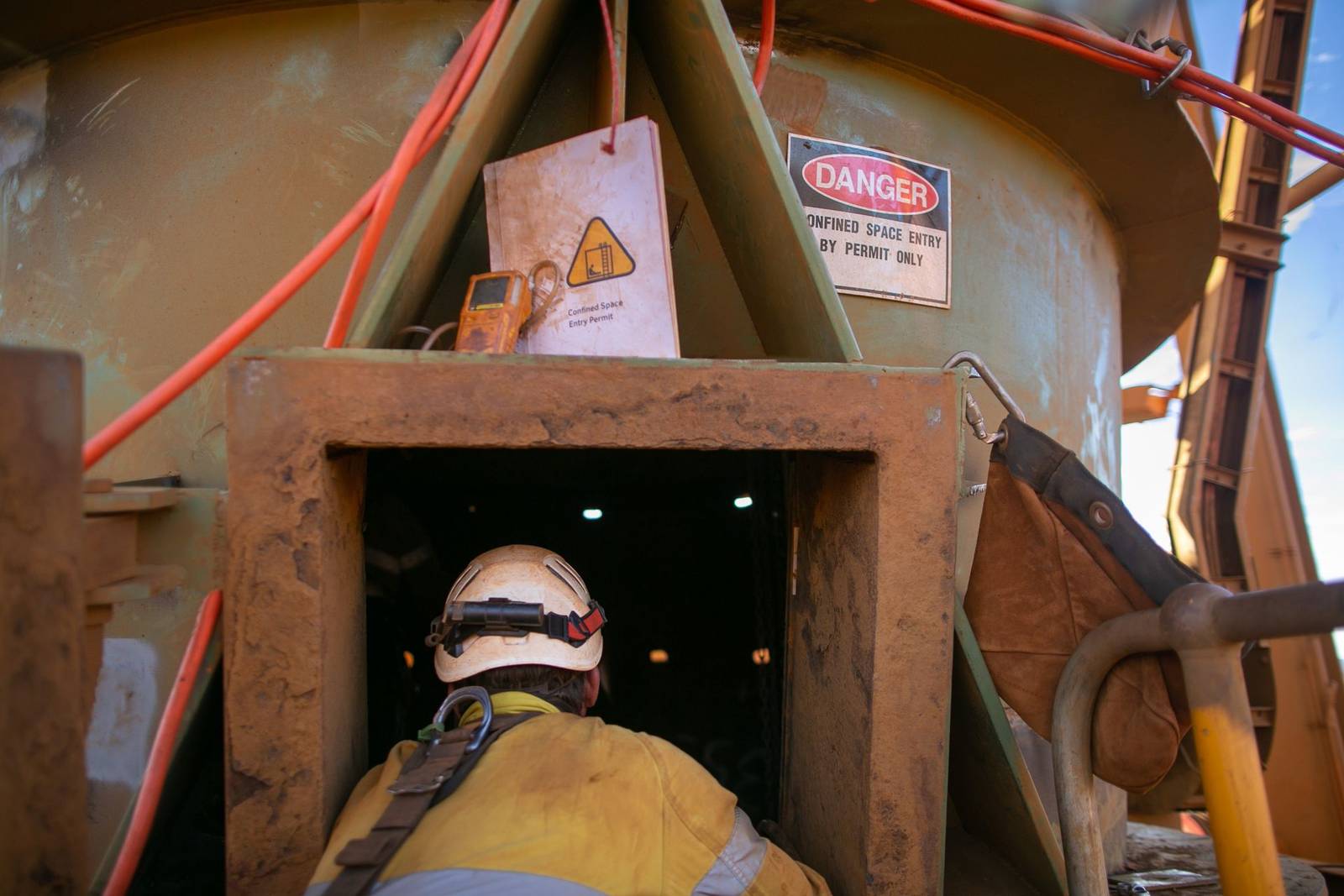
Confined spaces kill quietly, and they kill in multiples: OSHA and NIOSH incident data keep repeating the same grim pattern, where a would-be rescuer becomes the second or third fatality in a space that took the first victim in seconds. The regulation exists because good instincts — go help him — are exactly wrong inside a tank, a vault, or a pit with bad air. Training replaces instinct with procedure, and procedure is what brings everyone out.
3P Safety Training delivers confined space training on-site, as a team: the entrants who go in, the attendants who hold the line outside, and the entry supervisors who sign the permit all train together, on your actual spaces where practical. One visit produces a crew that can run a compliant permit entry from atmosphere testing to closeout — with the documentation to prove it.
The Rules: Two Standards, One Discipline
- General industry — OSHA 29 CFR 1910.146 — Permit-Required Confined Spaces. The permit-required confined space standard: written program, entry permits, testing, attendants, rescue arrangements, and annual program review. This governs plants, tanks, utility vaults, silos, and most fixed facilities.
- Construction — 29 CFR 1926 Subpart AA (1926.1201–1213). The construction rule adds requirements the general-industry standard does not have — most notably a competent person who must evaluate the jobsite, identify confined spaces, and determine which are permit-required (1926.1203), plus tighter coordination duties between hosts, controlling contractors, and entry employers.
If your crews build, renovate, or tie into spaces on someone else’s site, you live under both standards in the same month. We teach the overlap explicitly, because the gaps between the two rules are where citations grow.
First Principles: What Makes a Space “Permit-Required”
A confined space meets three tests: it is large enough to enter and work in, it has limited or restricted means of entry and exit, and it is not designed for continuous occupancy. It becomes permit-required when it adds any of the four hazards: a hazardous or potentially hazardous atmosphere, a material that can engulf an entrant, an internal configuration that can trap or asphyxiate (converging walls, sloped floors to a taper), or any other recognized serious hazard.
Getting this classification right — and documenting it — is half the program. Getting it wrong in the optimistic direction (“that’s just a pit”) is how entries happen with no permit, no attendant, no tested air, and no plan.
The Three Roles, Trained as a Team
| Entrant | Attendant | Entry Supervisor | |
|---|---|---|---|
| Core duty | Do the work inside — and get out alive | Guard the entry from outside, continuously | Authorize, oversee, and terminate the entry |
| Must know | Hazards, symptoms of exposure, equipment use, self-rescue, communication protocol | Hazard signs, entrant count, when to order evacuation, how to summon rescue — without ever entering | Permit requirements, testing verification, rescue availability, when to cancel a permit |
| Key authority | Exit on any alarm, symptom, or order — no discussion | Order immediate evacuation; bar unauthorized entry | Sign the permit; shut the entry down |
| Fatal error we train out | Ignoring symptoms to finish the task | Going in to help — the classic multiple-fatality trigger | Signing a permit without verifying the test results |
One person can hold more than one role across different entries, and supervisors often start as experienced entrants — but each role’s duties must be trained and documented separately. We train and evaluate each attendee for the roles they will actually hold.
What the Course Covers
- Recognizing confined spaces and applying the permit-required tests to your inventory of tanks, vaults, pits, boilers, digesters, crawl spaces, and vessels
- Atmospheric testing done right — test order (oxygen, then flammables, then toxics), acceptable ranges (19.5–23.5% oxygen, under 10% of the LFL, toxics below their limits), stratified-space sampling at multiple levels, and continuous monitoring during entry
- Calibration, bump testing, and why a monitor that was not bump-tested this shift is a guess with a display
- Ventilation — purging, dilution, local exhaust, and the intake-placement mistake that recirculates the exhaust you just removed
- Isolation and lockout/tagout of lines and energy: blanking, blinding, double block and bleed, and coordination with your LOTO program
- The entry permit line by line — who fills what, what voids it, and how it gets closed out
- Communication protocols, entrant tracking, and PPE including respiratory protection interfaces
- Rescue and retrieval — the standard’s preference for non-entry retrieval (tripods, winches, full-body harnesses on retrieval lines), evaluating rescue services under 1910.146(k), response-time reality, and why “the fire department” needs to have been consulted before it appears on your permit
- For construction crews: the Subpart AA competent-person evaluation and the host/controlling-contractor information exchange
Format, Duration, and Delivery
Instructor-led and on-site, typically a full day for a complete entry team covering all three roles; entrant/attendant-only sessions run shorter, and adding hands-on drills with your tripod, retrieval gear, and monitors extends the practical block — which we recommend, because the first time your attendant rigs the winch should not be during an emergency. We deliver anywhere in the U.S., scheduled around outages, turnarounds, and shift patterns.
What Your Crew Walks Away With
- Role-specific certificates and wallet cards — entrant, attendant, entry supervisor
- Written tests and, where hands-on drills are run, documented practical evaluations
- A training roster and records package formatted for your written program’s files
- A marked-up review of your entry permit form against the standard, if you bring one to class — most permits we see are missing at least one required element
- Clear retraining triggers: changed duties, new space hazards, permit-program deviations, or any sign the training did not hold
How the On-Site Visit Runs
- Scoping call. We ask for your space inventory (even a rough one), which roles need training and how many of each, whether your crews enter your own spaces or customers’ sites, and what rescue equipment you own. That last answer usually reshapes the practical block.
- Program documents in advance. Send your written program and blank entry permit if you have them — the class teaches on your paperwork, and we flag gaps against the standard as we go. No program yet? The course doubles as the outline for writing one.
- Training day. Classroom on classification, atmospheres, and roles in the morning; written test; then the practical block — live monitor work (bump test, fresh-air setup, stratified sampling on a real or simulated space), ventilation setup, and tripod/retrieval drills where your gear allows.
- Entry simulation. The day ends with a walk-through permit entry: supervisor authorizes, attendant logs and tracks, entrant works and communicates, someone triggers the abort. Ten minutes of simulation surfaces the confusion you want burned off before a real entry.
- Records same-day. Role-specific certificates, wallet cards, tests, drill documentation, and the marked-up permit review, handed to your safety contact before we leave.
Industries and Crews We Train
- Water and wastewater utilities — lift stations, digesters, wet wells, and the H2S discipline that goes with them (pair with H2S awareness where exposure warrants)
- Manufacturing and food plants — tanks, mixers, silos, pits, and the isolation/LOTO coordination that entry writers get wrong most often
- Municipal and utility crews — vaults, manholes, and the traffic-adjacent entries where the attendant is managing two hazard worlds at once
- Construction and mechanical contractors — Subpart AA competent-person duties, tie-ins on host sites, and the coordination paperwork between controlling contractors and entry employers
- Marine, agriculture, and energy — engulfment-heavy environments (grain, sand, produced fluids) where the retrieval plan is the whole ballgame
What Drives the Quote
Four inputs: how many people per role, whether you want the hands-on drill block with your rescue and monitoring equipment (you do), one site or several, and location for travel. A full entry-team day is the standard package; entrant/attendant-only refreshers run leaner. You get one price for the visit, sized to the team you described. Request a quote or call (252) 274-0583.
Why Train With 3P Safety
3P Safety is founder-led by Patrick Salazar — OSHA 500 authorized construction outreach trainer, working NCCCO-certified crane operator, certified crane inspector, and lift director, in the field since 2005, with federal-contract experience where confined space programs get audited to the letter. The course is taught by people who have stood attendant duty in the heat, not narrated it. Crews commonly pair this class with fall protection (vertical entries are both), a respiratory protection refresher, or forklift and aerial lift qualifications in the same on-site visit — one mobilization, one documentation standard.
The Program Failures We See Most
When a confined-space program goes wrong on paper, it goes wrong in one of five places: spaces never inventoried (the pit that “isn’t really a confined space”); permits photocopied and pencil-whipped instead of built from fresh test results; monitors that have not seen a bump test since the box they shipped in; rescue listed as “911” with no verification the responding department will enter that space with that hazard; and attendants assigned but not empowered — stationed at the hole with no radio, no entrant count, and no understood authority to order everyone out. The course is engineered against exactly this list, because these are not knowledge failures so much as system failures — and a trained entry supervisor is the person who keeps the system honest between our visits.
Reclassification and Alternate Procedures — the Legal Shortcuts, Used Legally
Not every permit space demands the full circus every time. The standard offers two disciplined shortcuts the class teaches properly: reclassification to non-permit status when all hazards are eliminated — not controlled, eliminated — with certification documenting it; and alternate entry under (c)(5) when continuous forced-air ventilation alone controls a purely atmospheric hazard, with monitoring data to prove it. Used right, they save enormous labor on routine entries. Used sloppily — “we always just vent it” without the data trail — they’re the paperwork gap an investigation finds first. Knowing which spaces on your site qualify, and documenting why, is part of the program review our class includes.
Frequently Asked Questions
Can the attendant ever leave the opening?
Not while entrants are inside — the attendant’s post is the program. They monitor conditions, keep the count, order evacuation, and summon rescue; they do not fetch tools, cover a second space (unless the program explicitly provides the means to do both duties for multiple spaces), and they never, ever enter for a rescue. The moment an attendant goes in, the site has zero attendants and two potential victims.
Is our fire department an acceptable rescue plan?
Only if they’ve verifiably agreed, are equipped and trained for your specific space types, and can respond in time for the hazards involved — and the standard expects you to evaluate that, not assume it. For atmospheric hazards where minutes decide outcomes, many departments honestly can’t make the math work. The class covers evaluating rescue services and the non-entry retrieval setups — tripods, winches, harnesses on entrants — that keep most rescues from requiring anyone else to go in at all.
What’s the difference between a confined space and a permit-required confined space?
All permit spaces are confined spaces; the permit label is added by hazard. If the space can enter/exit-restrict a worker and it carries a hazardous atmosphere, engulfment material, trapping configuration, or another serious hazard, it is permit-required — and the full program (permit, testing, attendant, rescue arrangement) applies to every entry.
Can one person serve as both attendant and entry supervisor?
A person can hold multiple roles if trained and equipped for each — but an attendant must remain stationed outside the space, performing only attendant duties, for the duration of the entry. The attendant can never double as an entrant during the same entry, and anyone attempting rescue from outside must never cross the plane of the opening without full rescue provisions.
How often does confined space training need to be renewed?
1910.146 requires retraining when duties change, when a space presents a hazard the employee was not trained on, when the employer has reason to believe the training did not stick, or when permit-program deviations occur. There is no fixed federal expiration date — but because monitor discipline and permit habits decay fast, most of our clients refresh entry teams annually or before major turnarounds.
Do we really need a rescue plan if we have never had an incident?
Yes — before any permit entry, not after the first incident. The standard requires you to evaluate and arrange a rescue service capable of responding in time for the hazards involved, and to prefer non-entry retrieval systems where feasible. More than half of confined-space fatalities in the classic NIOSH data are would-be rescuers; the plan exists to keep your best people from becoming the second victim.
What gas levels make a space safe to enter?
Acceptable entry conditions generally mean oxygen between 19.5% and 23.5%, flammables below 10% of the lower flammable limit, and toxic contaminants below their permissible limits — verified in the right order, at multiple levels in the space, with results recorded on the permit and monitoring continued during the entry. One clean reading at the hatch is not a characterization of the space.
Our spaces are on a customer’s site. Whose program applies?
Under the construction rule especially, information must flow between the host employer, the controlling contractor, and every entry employer — hazards, previous entries, program coordination. Your crew still needs its own trained roles and its own compliance; “the plant said it was fine” is not a defense. We teach the coordination duties explicitly for contractors who live on other people’s sites.