
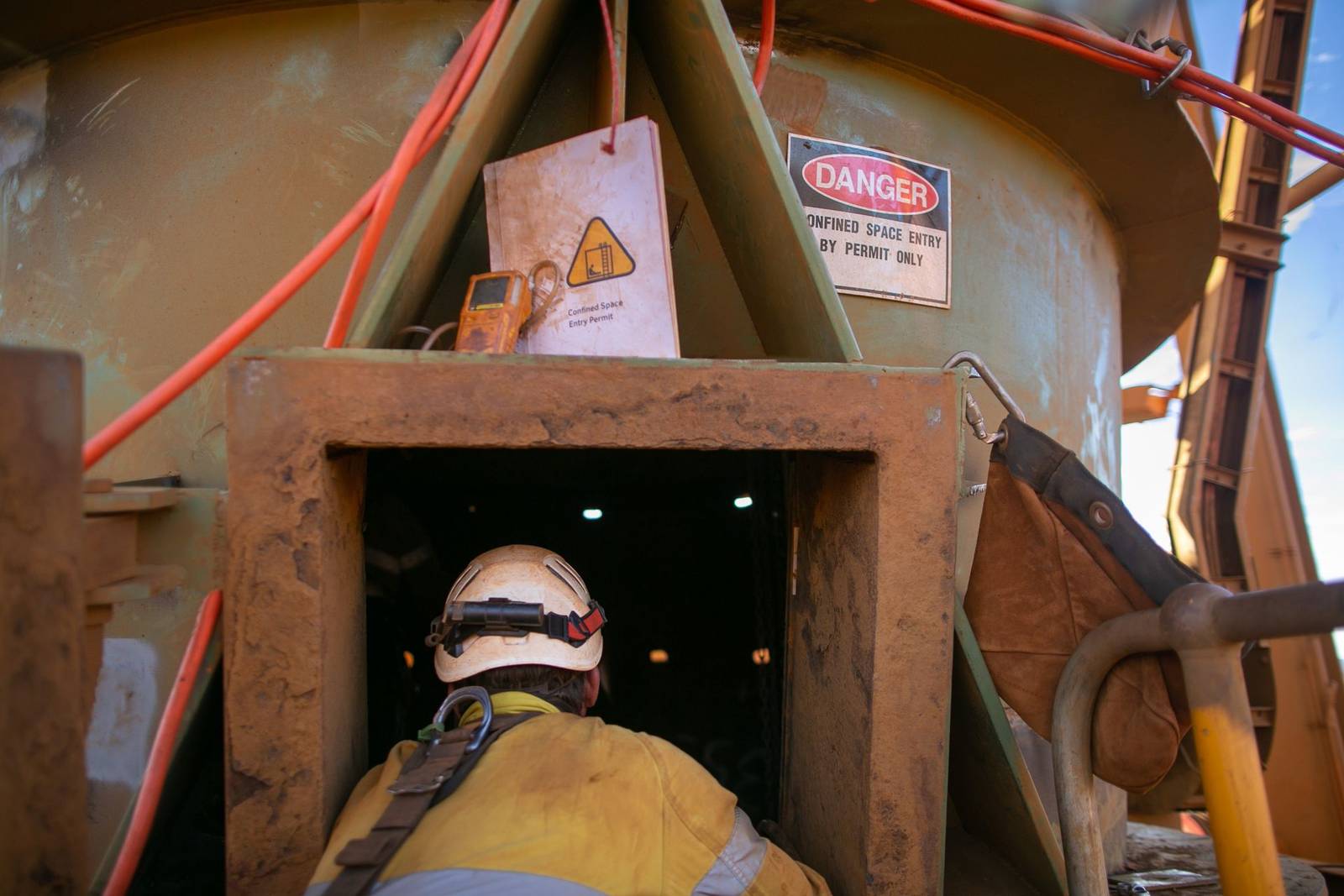
Hydrogen sulfide announces itself with a rotten-egg smell — and then, at the concentrations that actually kill, it destroys your sense of smell in seconds and gives no further warning. That is what makes H2S so lethal: workers trust their noses right up until the gas has already deadened them, and a single deep breath at high concentration can drop a person instantly. OSHA regulates it through exposure limits and the General Duty Clause, and in H2S-prone industries, awareness training is not a formality — it is survival training.
3P Safety Training delivers H2S awareness training on-site for the crews who face it: oil and gas operations, wastewater and confined spaces, tanneries, pulp mills, and any process where sulfur and decay produce the gas.
What Makes H2S So Dangerous
- It defeats your nose. Detectable by smell at low levels, it causes olfactory fatigue at higher ones — so “the smell went away” can mean the danger just got worse
- It is heavier than air and pools in low spots — pits, sumps, trenches, tank bottoms — exactly where confined-space work happens
- It is flammable and explosive as well as toxic
- It kills at concentrations measured in parts per million — high levels cause immediate collapse and death, which is why it is a leading cause of confined-space fatalities
What the Course Covers
- The properties and health effects of H2S across the concentration range, from irritation to immediate collapse
- Where H2S is generated and where it accumulates on your operation
- Gas monitoring: personal monitors, bump testing and calibration, alarm set points, and why a monitor is your real nose
- Exposure limits and what the readings mean for stay/go decisions
- Escape and self-rescue: reacting to an alarm, moving crosswind and upgrade, and escape respiratory protection
- The rescue trap: why untrained rescuers become the next victims, and what the plan says instead
- Where H2S work is confined-space entry and the two programs combine
- Emergency response, first aid for exposure, and site alarm and evacuation procedures
Format, Duration, and Delivery
A focused instructor-led session at your site, with hands-on time on the gas monitors your crews actually carry — bump testing and alarm response are muscle memory or they are nothing. It combines directly with confined space entry training wherever H2S and confined spaces overlap, which on most affected sites is constantly. Completers receive certificates and records; where H2S work involves confined spaces or requires escape SCBA, we make sure the training reflects that reality rather than treating H2S as a standalone lecture.
Who We Train
Any crew that works where hydrogen sulfide can accumulate needs awareness and escape training:
- Oil and gas operations — drilling, production, and servicing where H2S is a constant risk
- Wastewater and municipal utilities — lift stations, digesters, and wet wells
- Pulp, paper, and tanning operations — industrial processes that generate the gas
- Confined-space and marine crews — low spots where the heavier-than-air gas pools
How the On-Site Session Runs
We build the session around your operation and drill hands-on time on the gas monitors your crews actually carry, combining directly with confined-space training where the two overlap. We schedule around your operation — including off-shifts and turnarounds — and every session ends with certificates and a training record formatted for your files, handed over before we leave. One price for the visit: request a quote or call (252) 274-0583.
The Concentration Ladder Every Worker Should Know Cold
H2S risk is a ladder, and the class makes crews recite it: smell threshold under a single part per million — the nose is a remarkably sensitive detector at first; occupational exposure limits in the 10-to-20 ppm neighborhood depending on which rule governs your work; olfactory paralysis setting in around 100 ppm — the same territory the gas becomes immediately dangerous to life and health; collapse within breaths in the hundreds of ppm; and near-instant knockdown as concentrations approach a thousand.
The lesson inside the numbers: the smell warns you at the bottom of the ladder and betrays you near the top. A strong rotten-egg odor that suddenly “goes away” is a five-alarm signal, not relief — and that single fact, believed, has saved more lives than any respirator.
Where the Gas Actually Waits
H2S is heavier than air, so it pools where gravity sends it: tank bottoms, vaults, wet wells, pits, trench low spots, separator internals, and the downwind low ground around a release. It’s generated wherever sulfur meets decay or process — sour crude and gas streams, drilling and workover operations, wastewater lift stations and digesters, manure handling, pulp mills, geothermal work. The class maps your specific accumulation points, because “H2S country” isn’t a region — it’s the six spots on your site where the gas concentrates and a worker bends down into it.
Monitor Discipline: Bump, Calibrate, Believe
The personal four-gas monitor is the layer of protection between the ladder’s bottom and its top — if it’s working and worn right. The class drills the difference between the daily bump test (hit the sensor with gas, confirm alarm response, seconds per shift) and periodic calibration (adjusting accuracy against certified gas), typical alarm setpoints and what each demands, wearing the monitor in the breathing zone instead of clipped to a belt below a bench, and the one commandment that closes the module: when the alarm sounds, you leave — upwind and uphill — every time, without negotiation. A monitor whose alarms get debated is decoration.
The Second Victim Rule
The most repeated line in H2S fatality reports: a worker goes down, and a coworker rushes in to help — and becomes the second body. The atmosphere that dropped the first person is still there, and holding your breath is not a respiratory program. The class is unambiguous: entry for rescue happens only with supplied air — SCBA or airline — by people trained and equipped for it, with retrieval systems doing the reaching wherever the space allows. Everyone else’s job is the alarm, the muster, and the wind direction. Teaching a crew to not run in is the hardest and most valuable sell in this course.
Escape Sets: The Five Minutes of Air You Wear
On sour sites, the escape-only respirator is the piece of equipment most workers have strapped on and never actually deployed. The class fixes that with hands: what an emergency escape breathing device is and is not (five to fifteen minutes of air to get out — never to continue working, never to go help), the donning drill run until it takes seconds with gloves on and eyes closed, because the realistic scenario is an alarm, a plume, and adrenaline; and the inspection habit — cylinder gauge in the green, harness intact, last hydro date — that keeps the set trustworthy on the day it stops being luggage.
Where the site’s plan uses supplied-air work instead, we cover the boundary clearly: escape sets get you out of trouble; only a full respiratory program with SCBA or airline gear puts anyone into it.
Planning the Sour Site: Wind, Muster, and Zones
H2S survival is mostly geography decided in advance. The class teaches workers to read the site the way the plan was drawn: windsocks and streamers checked as a habit on every approach, because “upwind” is a direction that changes by the hour; primary and alternate muster points chosen so one of them is always crosswind of the source; and the zone logic behind staging areas, briefing spots, and where the trucks park nose-out. Crews learn the arrival ritual for any sour location — wind first, escape routes second, muster point third, then work — and supervisors get the checklist version for pre-job briefings, including the visitor problem: the delivery driver and the surveyor who walked into the zone knowing none of it.
The Paper Behind the Card: Contingency Plans and ANSI Z390.1
Serious H2S programs are audited against more than OSHA’s exposure limits. ANSI/ASSP Z390.1 — the accepted-practice standard for H2S training — sets expectations for course content, instructor qualification, and refresher cadence, and it’s the yardstick operators and drilling contractors increasingly write into their site rules; our awareness course is built to align with it. The class also walks where the site contingency plan comes from — the document that sets alarm levels, evacuation triggers, roles, and notification chains on sour locations — and what a worker is entitled to know from it before the first shift. Your records package ties it together: roster, quiz, certificate, and the training content documented so a client audit or an operator’s site-access check clears in minutes.
Frequently Asked Questions
Is annual H2S refresher training actually required?
No single federal H2S standard sets a clock, but the industry norm is unambiguous — operators, primes, and site orientations across oil and gas and wastewater expect a card dated within twelve months, and the ANSI Z390.1 framework this course follows assumes annual refresh. We date the cards accordingly and flag your renewal window before it closes.
Do office and delivery personnel at a sour site need the course?
Anyone who could plausibly be in an affected area during a release needs at least awareness — the alarm meaning, the muster points, the upwind rule. Most sour-service sites solve this by requiring the awareness card at the gate, which is exactly the class we deliver, and short-form orientations cover true visitors under escort.
Does a respirator substitute for monitoring?
No — they answer different questions. The monitor tells you the atmosphere; escape respirators buy you the exit; supplied air enables planned work in known concentrations under a full respiratory protection program. Sites get in trouble when gear substitutes for knowledge; the course keeps the order straight: measure, then decide, then breathe accordingly.
Why can’t workers just rely on the smell of H2S?
Because the smell fails exactly when it matters most. H2S is detectable at very low concentrations, but at higher, dangerous levels it rapidly paralyzes the sense of smell — so a worker who notices the odor fading may be walking into a lethal concentration, not out of one. The only reliable detection is a calibrated gas monitor, which is why the course centers on the instrument, not the nose.
Is H2S training legally required?
OSHA enforces H2S through permissible exposure limits and the General Duty Clause, and where confined spaces are involved, the confined-space standard’s atmospheric-testing and training requirements apply directly. In oil and gas and many industrial settings, H2S awareness is also a near-universal contractor and site access requirement — you will not get on the pad without it.
What do workers do when the monitor alarms?
Leave immediately — move crosswind and to higher ground, away from where the heavier-than-air gas pools, without stopping to investigate. Because H2S is heavier than air and collects in low areas, the escape direction matters. The course drills the alarm response so it happens on reflex, before the brain has time to rationalize staying.
Can our crew perform an H2S rescue?
Not without proper training, atmospheric monitoring, and respiratory protection — H2S rescues are a leading way for would-be rescuers to become additional fatalities. The plan for most crews is escape and summon trained rescue, not entry. Where your operation genuinely needs entry rescue capability, that is a higher tier of training we scope separately.
Are personal monitors enough, or do we need fixed gas detection?
They answer different questions. The personal monitor protects the worker wearing it, wherever they walk; fixed detection watches a location — a wellhead, a wet well, a compressor building — and alarms the whole area, often before anyone arrives. Most sour sites need both, and the class teaches crews what each system is telling them and which alarm means what under your site’s plan.
We’ve never had an H2S reading on this site. Do we still need training?
If the process, the formation, or the waste stream can produce it, yes — history is not a control. Sewers and digesters generate H2S episodically, sour zones shift as fields age, and the deadliest incidents cluster exactly where crews stopped expecting the gas. Training and monitoring are what make a quiet site provably quiet instead of assumed quiet.
How long do the monitors themselves last?
Electrochemical H2S sensors typically live two to three years, and they die quietly — which is the entire argument for the daily bump test. The class covers sensor life, expiration tracking, and the fleet habit of staggering replacements so the whole site’s monitors don’t age out the same month.