
Hazard communication is the most-cited standard in general industry nearly every year, and the citation is rarely exotic: no written program, missing training records, orphan chemicals with no SDS on file. The rule (29 CFR 1910.1200) is often called the “right-to-know” standard, and since its alignment with the Globally Harmonized System it is really a right-to-understand standard — workers must be trained to read the labels and data sheets in front of them.
3P Safety Training delivers HazCom training on-site, built around your actual chemical inventory. Instead of stock slides about generic solvents, your crew trains on the drums, totes, and spray cans in their own shop.
What the Standard Requires
- A written hazard communication program naming responsibilities, the inventory, and how labels and SDSs are managed
- A chemical inventory matched to a safety data sheet for every hazardous chemical on site, accessible to workers during their shift
- GHS-compliant labels on shipped containers — and workplace labeling for secondary containers, where most violations actually happen
- Training at initial assignment and whenever a new chemical hazard enters the workplace — in a language and manner employees understand
What the Course Covers
- Reading a GHS label: signal words, the nine pictograms, hazard statements, and precautionary statements — decoded on your own products
- Navigating the 16-section SDS: where the firefighting, first-aid, PPE, and spill information actually lives when you need it fast
- Physical versus health hazards, routes of exposure, and what “chronic” means to a 20-year employee
- Secondary-container labeling — the transfer bottle rule that catches nearly every shop
- Non-routine tasks and contractor chemical exchange, the two program corners inspectors probe
- Your written program, reviewed live: attendees leave knowing where it is and what it says
Format, Duration, and Who Should Attend
An instructor-led session at your facility, tailored in length to your job and crew, covering every employee who works with or around hazardous chemicals — production, maintenance, warehouse, and janitorial alike. Larger plants run multiple sessions across shifts in one visit. Completers receive certificates and a training record formatted for your written program; where the program itself has gaps, we flag them in writing so your safety lead can close them.
Who We Train
Any operation that stores or uses hazardous chemicals owes its workers HazCom training — and that is nearly everyone:
- Manufacturing and processing — solvents, coatings, acids, and the reactive-hazard storage inspectors probe first
- Warehousing and distribution — mixed chemical inventories moving through the building daily
- Automotive, fleet, and repair shops — fuels, cleaners, and the secondary-container labeling that trips up every garage
- Janitorial, facilities, and food service — industrial-strength cleaners used at industrial frequency
How the On-Site Session Runs
We build the class around your actual chemical inventory and walk your written program live, so workers train on the labels and safety data sheets they will really pull. We schedule around your operation — including off-shifts and turnarounds — and every session ends with certificates and a training record formatted for your files, handed over before we leave. One price for the visit, sized to your headcount: request a quote or call (252) 274-0583.
Reading a GHS Label in Ninety Seconds
The label system only works if workers can decode it at a glance, so the class drills the anatomy until it’s automatic: the product identifier that matches the SDS on file, the signal word — Danger outranks Warning, and the difference matters — the hazard statements, the precautionary statements that tell you what to actually do, and the nine red-diamond pictograms.
We spend real time on the pictograms crews misread: the health hazard silhouette (chronic effects — carcinogens, sensitizers) versus the exclamation mark (acute irritants), the gas cylinder that means pressure not poison, and the corrosion diamond that applies to metals and skin alike. Ninety seconds with a label should tell a worker what it is, what it does, and what to wear — that’s the pass bar for the exercise.
The SDS Has Sixteen Sections — Four Matter in a Hurry
Safety data sheets follow a fixed sixteen-section format, and the class teaches the whole map — but it drills the four a worker needs under pressure: Section 2 (hazard identification — what this can do to you), Section 4 (first aid — what to do in the first minute), Section 6 (spill response — contain or evacuate), and Section 8 (exposure controls and the PPE this chemical actually demands). A crew that can find those four sections in under a minute has a functioning right-to-understand program; a binder nobody opens is a prop.
We run the drill on your own SDS library — and when the library’s missing sheets for chemicals on the shelf, that gap becomes your punch list before it becomes a citation.
The Secondary-Container Trap
The everyday HazCom citation isn’t the drum from the supplier — it’s the spray bottle someone filled from it. The moment product leaves its labeled container into a bottle, pail, or tank that outlives the task or leaves the transferring worker’s hands, it needs workplace labeling: identity plus hazard information. The class fixes this culturally, not just procedurally — blank workplace labels at the fill station, a two-second habit, and the unlabeled-bottle problem dies. It’s the cheapest correction in the entire compliance catalog.
The Written Program and the Inventory Behind It
Training legally sits on top of a written hazard communication program: the chemical inventory, who maintains the SDS library and how workers access it, labeling procedures, and how contractors exchange hazard information with you. Inspectors ask for the written program first — before they ever quiz a worker. Ours comes with the class: we review yours against the standard, or leave you a working draft built from your actual inventory, so the document and the training tell the same story.
Non-Routine Tasks: The Tank Cleaning Nobody Trained For
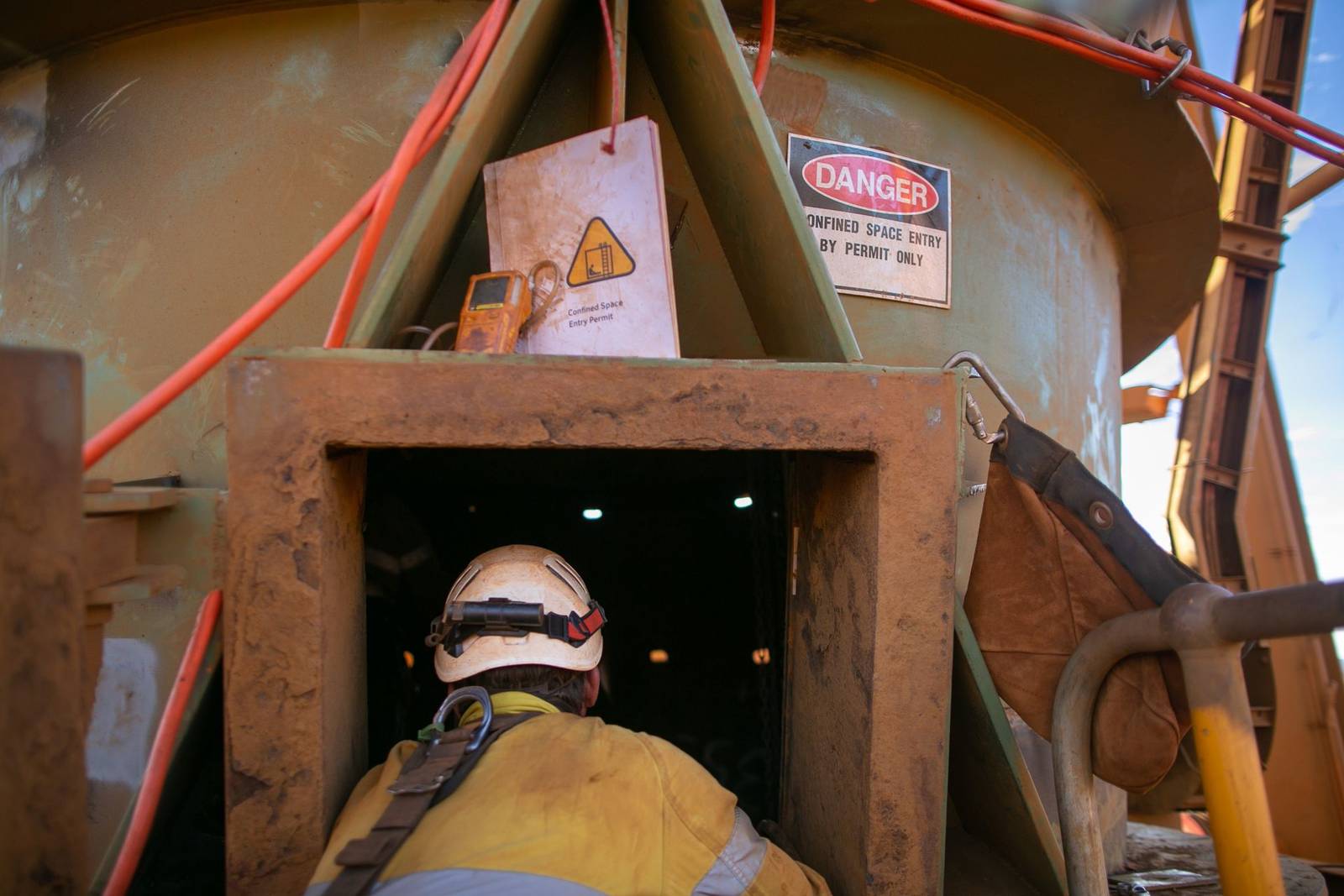
The standard has a clause written specifically for the job that kills experienced workers: employers must inform employees of the hazards of non-routine tasks — the annual tank cleanout, the line break on a system that runs sealed all year, the maintenance job inside equipment the operators never open. These are exactly the exposures daily training never touches, because they aren’t daily. The class teaches supervisors to treat the non-routine task as its own briefing trigger: what’s in the system, what the SDS says about it in confined quarters, what the flush or purge actually removed and what it didn’t, and which permits — confined space, hot work — ride along. One planning conversation before the odd job is the entire compliance mechanism, and we leave a one-page briefing form that makes it a habit.
Pipes: The Unlabeled Middle of the Plant
GHS labels live on containers, but half the chemical inventory in a process facility spends its life moving through pipe — and workers must still be trained on the hazards of chemicals in unlabeled pipes before they cut, tap, or open them. The class connects the dots your maintenance crew needs: how to identify what a line carries before work starts (P&IDs, valve tags, your pipe-marking scheme where one exists), who answers when the drawing and the reality disagree, and why the ANSI/ASME A13.1 color bands — where your plant uses them — are a reading skill worth sixty seconds of class time. The line-break brief becomes the habit: contents confirmed, energy isolated, and the SDS consulted before the first flange bolt turns.
Contractors and the Two-Way Exchange
The multi-employer clause is the part of HazCom that fails between companies instead of inside one. When contractors work your site, the standard expects a two-way exchange before work starts: they learn what your processes could expose their people to and where your SDSs live; you learn what they’re bringing through your gate — the solvent in the sub’s van, the coating with the isocyanate hardener your ventilation was never designed around. The class gives both sides of that handshake a working format: a one-page site chemical brief for arriving crews, a bring-list requirement written into contractor agreements, and the escalation for surprises found mid-job. General contractors and host plants run this block for their supervisors specifically, because the exchange is a supervisor duty in practice — and its absence is a shared citation when the incident lands.
Training Crews in the Language They Think In
OSHA’s interpretation is settled: training must be presented in a manner and language employees actually understand, and a roster signature under an English-only class a third of the crew couldn’t follow is documentation of the violation, not the compliance. We deliver HazCom in Spanish with materials to match when your workforce calls for it, run mixed classes with genuine bilingual instruction rather than a translated slide title, and build the quiz so comprehension gets demonstrated instead of assumed. The label-and-SDS skills carry a wrinkle worth naming: the SDS on the wall will be in English, so the class teaches the pictograms and section numbers as the language-independent layer — the symbols read the same in any language, which is precisely why GHS chose symbols.
Training That Recurs on Its Own
HazCom training is triggered at assignment and again whenever a new hazard class enters the workplace — not on a calendar. That trigger only works if somebody owns it, so we help you wire it into purchasing: new chemical arrives, SDS gets filed, hazard classes get compared against what the crew already knows, and a short delta-training happens only when something genuinely new shows up. The records package we leave — roster, quiz, topic outline, certificates — is formatted so each round drops into the same file, and the annual review takes minutes instead of a weekend. Facilities pairing this class with respiratory protection or PPE get the chemical-to-control story told end to end in one visit.
Frequently Asked Questions
When is HazCom retraining required?
Whenever a new chemical hazard enters the workplace — a new product class, not every new brand of the same thing — and whenever the program itself changes. There’s no fixed annual requirement, but most operations fold a HazCom refresher into their yearly training day because inventories drift and new hires accumulate.
Do office areas need HazCom training?
Not for ordinary consumer-level use — the standard exempts products used the way a household would use them. The line gets crossed when quantities or frequency exceed consumer patterns, which is why the janitor’s closet and the print shop count while the desk-side hand sanitizer doesn’t. We map the line for your building during class prep.
Can SDS access be digital only?
Yes, if it’s reliable and immediate for every worker on every shift — no barriers like a supervisor’s login, and a backup for power or network failure. A tablet at the supervisor’s station plus a documented fallback usually passes; “it’s on the corporate intranet somewhere” does not.
Do we need an SDS for things like Windex or WD-40?
If employees use consumer products the way a consumer would — same duration, same frequency — they can fall outside the rule. Use them at industrial scale or frequency and they are in your program. The honest answer for most shops: keep the SDS; it costs nothing and ends the argument.
What about chemicals in unlabeled spray bottles?
That is the classic secondary-container violation. Anything transferred out of its labeled container needs workplace labeling unless it stays in the hands of the person who filled it and is used within the shift. We teach a labeling habit that survives real production pressure.
Does HazCom cover contractors on our site?
Both directions: you must inform contractors about the chemical hazards they will encounter, and they owe you the same for what they bring. The exchange mechanism belongs in your written program — it is a standard inspector question on multi-employer sites.
Who trains temp workers — us or the staffing agency?
Both, on different halves. The agency typically owes the generic HazCom foundation; the host employer owes site-specific training — your chemicals, your labeling system, your SDS access — because only you can teach it. OSHA’s temporary-worker guidance treats the two employers as jointly responsible, so the contract should say who does what and the file should show both happened.
Are pesticides, drugs, or cosmetics covered by HazCom?
They’re carved out where another agency’s labeling law governs — pesticides under FIFRA, drugs and cosmetics under FDA rules, consumer products used as a consumer would. The exemptions are narrower than people hope: a cleaner used all shift, every shift, at industrial strength is workplace chemical exposure, whatever the retail label looks like.